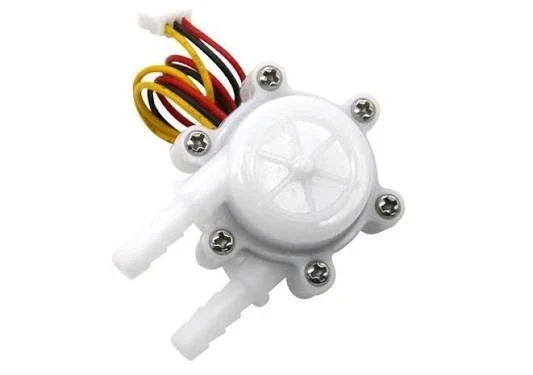
2103 Micro Hall Water Flow Sensor | 7mm Mini Flow Sensor
The 2103 Micro Hall Water Flow Sensor is a compact liquid flow sensing device designed for measuring and detecting water flow in small pipes and fluid systems. It uses a Hall-effect sensing mechanism and a rotating impeller to generate pulse signals as water passes through the sensor.
Its miniature size makes it particularly useful for coffee machines, water dispensers, water purifiers, small pumps, laboratory projects, IoT devices, Arduino projects and embedded water-flow monitoring systems. Similar 2103 listings identify this type of sensor as a 7 mm micro flow sensor, while manufacturer specifications for comparable micro Hall sensors show pulse-based output and low-flow applications.
For Bangladeshi students, electronics hobbyists and engineers, the sensor can be connected to a microcontroller such as Arduino, ESP8266, ESP32, STM32 or other digital controllers to detect water movement and calculate flow based on the generated pulses.
Important: Specifications such as exact flow range, pulse constant, operating voltage and connector can vary between 2103 versions/suppliers. Verify the seller's datasheet or product sample before designing a production system.
Features:
- Model: 2103 Micro Hall Water Flow Sensor
- Compact and lightweight micro flow sensor
- Hall-effect pulse sensing technology
- Suitable for water and compatible liquid-flow applications
- Small 7 mm class flow passage commonly associated with 2103 listings
- Digital pulse output
- Easy integration with Arduino, ESP32, ESP8266 and other microcontrollers
- Suitable for low-flow applications
- Useful for water-flow detection and measurement
- Simple installation with compatible tubing
- Ideal for DIY electronics and IoT projects
- Commonly used in coffee machines, water dispensers and water-purification equipment
Specifications:
| Specification | Details |
|---|---|
| Product Name | 2103 Micro Hall Water Flow Sensor |
| Sensor Type | Hall Effect Water Flow Sensor |
| Detection Method | Rotating impeller + Hall sensing |
| Medium | Water / compatible liquids |
| Output | Pulse signal |
| Flow Passage | Approx. 7 mm class* |
| Installation | Inline with water tubing |
| Interface | Digital pulse output |
| Controller Compatibility | Arduino, ESP32, ESP8266, STM32 and similar MCUs |
| Application | Water-flow detection and measurement |
| Construction | Compact plastic micro-flow sensor |
| Typical Applications | Coffee machine, water dispenser, purifier, IoT and DIY projects |
*Exact specifications depend on the particular 2103 version. Comparable micro Hall sensors are available with substantially different voltage, flow-range and pulse characteristics, so the exact supplier datasheet should be used for engineering calculations.
How Does the 2103 Water Flow Sensor Work?
The 2103 uses a small internal impeller coupled to a magnetic sensing system. When water flows through the sensor, the impeller rotates. The Hall sensor detects the magnetic movement and produces electrical pulses.
A microcontroller counts these pulses to determine whether water is flowing and, when the sensor's calibration constant is known, estimate the flow rate.
Basic flow:
Water Flow → Internal Impeller → Magnetic Rotation → Hall Sensor → Pulse Output → Microcontroller
The pulse-frequency relationship is sensor-specific. For example, one comparable micro Hall sensor specifies its relationship as F = 18Q + 5%, where Q is flow in L/min, demonstrating why the correct model-specific calibration value is important.
Related Products


