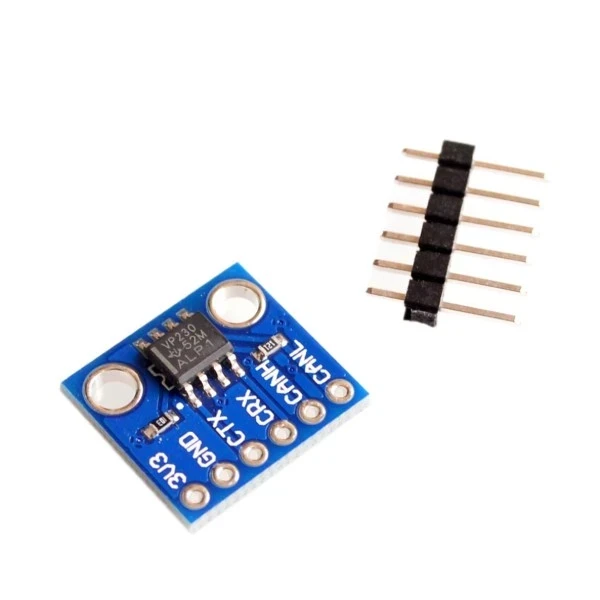
MCU-230 MCU230 SN65HVD230 CAN Communication Module
The MCU-230 MCU230 SN65HVD230 CAN Communication Module is a compact 3.3 V CAN bus transceiver module designed to connect microcontrollers and embedded systems to a Controller Area Network (CAN Bus). Based on the SN65HVD230 CAN transceiver, this module provides differential CAN communication for applications such as automotive electronics, industrial automation, robotics, IoT devices, sensor networks, and embedded communication systems.
The SN65HVD230 supports CAN communication speeds of up to 1 Mbps and is compatible with the ISO 11898-2 High-Speed CAN physical layer. It is designed to interface a CAN controller in a microcontroller with the differential CANH and CANL bus.
Its 3.3 V supply operation makes it particularly useful with modern development boards and microcontrollers such as ESP32, STM32 and other 3.3 V CAN-enabled controllers. The transceiver includes protection features such as thermal shutdown, open-circuit fail-safe operation, bus ESD protection and protection against several common bus fault conditions.
For Bangladeshi students and electronics engineers, the MCU-230 is a practical choice for learning CAN Bus communication, developing embedded networking projects, connecting multiple controllers, and experimenting with automotive or industrial CAN networks.
Features:
- Based on SN65HVD230 CAN transceiver
- 3.3 V single-supply operation
- High-Speed CAN physical-layer transceiver
- CAN communication rate up to 1 Mbps
- Compatible with ISO 11898-2
- Differential CANH and CANL communication
- Low-power standby mode
- Thermal shutdown protection
- Open-circuit fail-safe design
- Bus and pin ESD protection
- Suitable for 3.3 V microcontrollers
- Useful for ESP32, STM32 and embedded CAN projects
- Suitable for automotive, robotics, industrial and IoT applications
- Compact module format for prototyping
Specifications:
| Specification | Details |
|---|---|
| Product Name | MCU-230 / MCU230 CAN Communication Module |
| Main IC | SN65HVD230 |
| Interface | CAN Bus |
| CAN Standard | ISO 11898-2 compatible |
| Supply Voltage | 3.0–3.6 V |
| Typical Supply | 3.3 V |
| Maximum Signaling Rate | Up to 1 Mbps |
| CAN Channels | 1 |
| CAN Bus Lines | CANH, CANL |
| Logic Interface | TXD, RXD |
| Standby | Supported |
| Protection | ESD, thermal shutdown and bus fault protection features |
| MCU Compatibility | 3.3 V CAN controllers |
| Typical Applications | Automotive, robotics, industrial automation, IoT |
| Transceiver Package | SN65HVD230 SOIC-8 |
| Operating Temperature | -40°C to +85°C for the standard SN65HVD230 device |
The SN65HVD230 itself has a specified 3.0–3.6 V supply range, supports up to 1 Mbps signaling, and has an operating temperature range of -40°C to +85°C.
MCU-230 Pin Function:
Typical SN65HVD230 module connections are:
| Pin | Function | Description |
| VCC | Power | 3.3 V supply |
| GND | Ground | Power and signal ground |
| TXD | CAN TX | Connect to MCU CAN transmit output |
| RXD | CAN RX | Connect to MCU CAN receive input |
| CANH | CAN Bus High | Differential CAN bus line |
| CANL | CAN Bus Low | Differential CAN bus line |
| RS | Mode/Slope Control | Controls transceiver operating mode |
| VREF | Reference | CAN transceiver reference output |
Always check the exact PCB silkscreen and module revision before wiring because commercially available MCU-230 boards can differ in pin headers, termination components and layout.
How the SN65HVD230 CAN Module Works
A microcontroller with an integrated CAN controller generates CAN transmit data through the TXD interface. The SN65HVD230 converts the single-ended logic signal into differential CAN signals on CANH and CANL.
On the receiving side, differential CAN bus signals are converted back into a logic-level RXD signal for the microcontroller's CAN controller.
This means the SN65HVD230 is primarily the physical-layer transceiver. It does not replace a microcontroller's CAN protocol controller.
Basic Communication Flow
MCU CAN Controller → TXD → SN65HVD230 → CANH/CANL → CAN Bus → SN65HVD230 → RXD → MCU CAN Controller
This makes the module useful with microcontrollers that already provide a CAN controller, such as suitable STM32 devices and ESP32 variants with CAN/TWAI capability.
CAN Bus Termination
A properly designed CAN network generally requires 120 Ω termination at each physical end of the bus. When using two CAN nodes on a short test network, termination is particularly important for reliable communication.
Do not automatically add multiple termination resistors to every CAN module. Check whether your MCU-230 board already contains a termination resistor and whether it should be enabled or disabled for your particular network.
Applications:
The MCU-230 SN65HVD230 CAN Communication Module can be used for:
- ESP32 CAN Bus projects
- STM32 CAN communication
- Automotive electronics experiments
- Vehicle CAN Bus research
- Industrial automation
- Robotics communication
- Motor controller networks
- Sensor networks
- Embedded controller networking
- IoT communication systems
- CANopen experiments
- DeviceNet-related learning
- Building automation
- HVAC control systems
- Distributed embedded systems
- University electronics projects
- Arduino-compatible CAN experiments when paired with an appropriate CAN controller
TI lists industrial automation, control, sensors and drive systems, motor and robotic control, building/climate control and CAN-based standards among applications for the SN65HVD23x family.
Related Products


