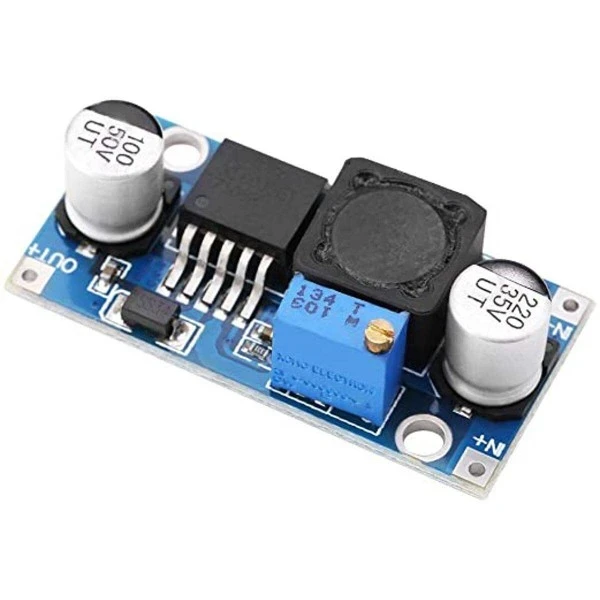
XL6009 Step-Up DC-DC Boost Converter Module 3V-32V to 5V-35V Adjustable
XL6009 Step-Up DC-DC Boost Converter Module
The XL6009 Step-Up DC-DC Boost Converter Module is a compact adjustable DC-DC power supply module for increasing a lower DC voltage to a higher DC voltage. Based on the XL6009 switching regulator, this module is widely used in electronics projects that need a flexible and adjustable boost power source.
The commonly available XL6009 module supports an input range of 3V to 32V DC and an adjustable output range of 5V to 35V DC. The output voltage can be adjusted using the onboard potentiometer, making the module convenient for prototyping, educational electronics, robotics, automation and DIY power-supply applications.
The XL6009 uses a high-frequency switching design and is commonly specified at around 400kHz switching frequency, with manufacturers and module sellers often stating efficiency of up to 94% under suitable operating conditions. Efficiency varies with input voltage, output voltage, current and thermal conditions.
Why use an XL6009 Boost Converter?
When your available power source has a lower voltage than your circuit requires, a boost converter can increase the voltage efficiently compared with simply using a linear regulator. For example, a battery or low-voltage DC source can be converted to a higher voltage required by a circuit.
The XL6009 module includes clearly marked IN+, IN-, OUT+ and OUT- terminals, making wiring straightforward for beginners as well as experienced electronics users.
Common Applications
The XL6009 boost module can be used for:
- Arduino and microcontroller projects
- ESP32 and embedded electronics
- Robotics projects
- DIY adjustable power supplies
- Battery-powered electronics
- LED circuits
- Sensor and module power systems
- Electronics laboratory experiments
- Prototype PCBs and breadboard projects
- Solar-powered electronics
- Portable electronic devices
- Voltage boosting for DC motors and other loads where the electrical requirements are suitable
How to Use XL6009
Connect your DC source to IN+ and IN-. Connect the load to OUT+ and OUT-. Before connecting sensitive electronics, measure the output voltage with a multimeter and carefully adjust the onboard potentiometer until the desired voltage is reached. The manufacturer documentation describes the same basic connection and adjustment procedure.
Important Current and Power Note
Although many marketplace listings describe the XL6009 module as a 4A boost converter, the 4A figure should not automatically be interpreted as 4A continuous output at every voltage. The XL6009 module's actual usable output current is affected by the input voltage, output voltage, conversion efficiency, heat dissipation, PCB design and ambient temperature. Independent testing of commonly sold HW-432 modules has also questioned the practicality of treating the advertised 4A rating as a continuous-output specification.
For higher-power applications, provide appropriate cooling and verify voltage, current, temperature and output ripple under the actual load.
Specifications:
| Specification | Details |
|---|---|
| Product Type | DC-DC Step-Up Boost Converter |
| IC | XL6009E1 |
| Converter Type | Non-Isolated Boost |
| Rectification | Non-Synchronous |
| Input Voltage | 3V to 32V DC |
| Optimum Input Range | Approximately 5V to 32V |
| Output Voltage | Adjustable 5V to 35V DC |
| Adjustment | Onboard Potentiometer |
| Maximum Input/Switch Current | 4A max |
| Switching Frequency | 400kHz |
| Stated Efficiency | Up to 94% |
| Output Ripple | Approximately 50mV under specified conditions |
| Load Regulation | ±0.5% |
| Voltage Regulation | ±0.5% |
| Operating Temperature | -40°C to +85°C |
| Approx. Module Size | 43 × 21 × 14 mm |
| Terminals | IN+, IN-, OUT+, OUT- |
Specifications can vary among different XL6009 board revisions and sellers, especially output-current claims and physical dimensions.
Pinout
| Pin | Function |
|---|---|
| IN+ | DC Input Positive |
| IN- | DC Input Negative / Ground |
| OUT+ | Boosted Output Positive |
| OUT- | Boosted Output Negative / Ground |
Related Products


