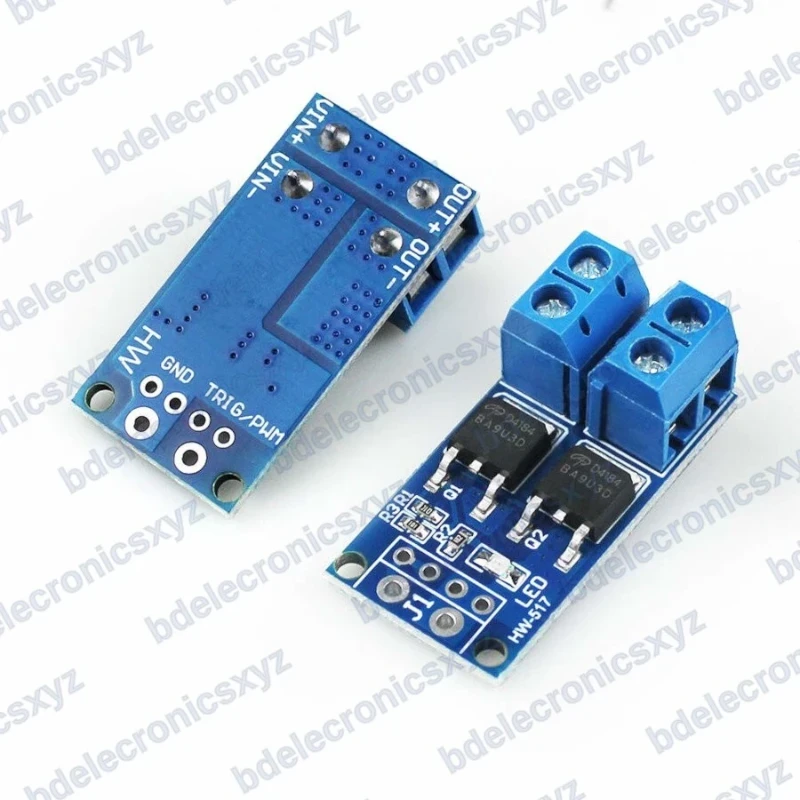
5A 400W Dual MOSFET Driver Module | DC PWM Power Switch Controller for Motor, LED & Electronic Loads
The 5A 400W Dual MOSFET Driver Module is a high-power electronic switching module designed for controlling DC loads using PWM (Pulse Width Modulation) signals. It provides an efficient way to switch and regulate electrical power for applications such as DC motors, LED lighting, pumps, fans, solenoids, heating elements, and other compatible electronic devices.
This dual MOSFET driver module uses two MOSFET transistors to control electrical loads through electronic switching. It is suitable for electronics enthusiasts, engineering students, technicians, and developers working on automation, robotics, embedded systems, and DIY electronics projects.
The module can be useful in projects requiring DC power switching, PWM-based speed control, and electronic load management. With a compatible PWM control signal, users can adjust the switching duty cycle to regulate the average power delivered to a connected load. This makes it useful for experimenting with motor speed control, LED brightness adjustment, and other DC power control applications.
For Arduino, ESP32, ESP8266, and other microcontroller-based projects, a compatible control signal can be used to operate the MOSFET switching circuit. This allows developers to integrate electronic load control into automated systems, smart devices, robotics projects, and IoT applications. Check the actual module's trigger voltage and input specifications before connecting a microcontroller.
The 5A 400W MOSFET driver board is also useful for controlling DC electrical loads in DIY automation systems. Depending on the connected load and circuit design, it can be incorporated into DC motor controllers, LED dimmers, cooling fan controllers, pump switching systems, and electronic switching projects.
One important advantage of a MOSFET-based switching module is its ability to control DC loads electronically without relying on traditional mechanical relay contacts. PWM operation can provide smoother power adjustment for compatible loads and support automated control through programmable electronics.
For reliable operation, users should consider the load's operating voltage, continuous current requirements, startup current, switching frequency, and thermal conditions. The advertised 400W maximum power rating should not be treated as a guaranteed continuous operating rating. Actual power capability depends on the board design, MOSFET specifications, PCB copper thickness, cooling arrangements, and ambient temperature.
Bangladeshi electronics students and engineers can use this module for practical learning, prototyping, automation experiments, and DC power control applications. It is particularly useful for understanding MOSFET switching, PWM control, microcontroller interfacing, and electronic load management.
Whether you are developing a robotics project, building an automated DC motor controller, experimenting with LED dimming, or designing an embedded electronics system, the 5A 400W Dual MOSFET Driver Module offers a practical platform for DC load switching and PWM control.
Product Specifications
|
Parameter |
Specification |
|---|---|
|
Product Name |
Dual MOSFET Driver Module |
|
Model |
5A 400W |
|
Module Type |
MOSFET Power Driver |
|
Number of MOSFETs |
2 |
|
Rated Power |
400W (advertised maximum) |
|
Current Rating |
5A (verify product datasheet) |
|
Operating Voltage |
Confirm from actual board |
|
Control Method |
PWM / Digital Switching |
|
Input Signal |
Confirm trigger voltage |
|
Load Type |
Compatible DC loads |
|
Applications |
Motors, LEDs, Fans, Pumps |
|
Interface |
Control Signal Input |
|
Package |
Driver Module PCB |
Important: Confirm the PCB markings and manufacturer's specifications for operating voltage, trigger voltage, PWM frequency, and continuous current before publishing these as confirmed specifications.
Related Products


