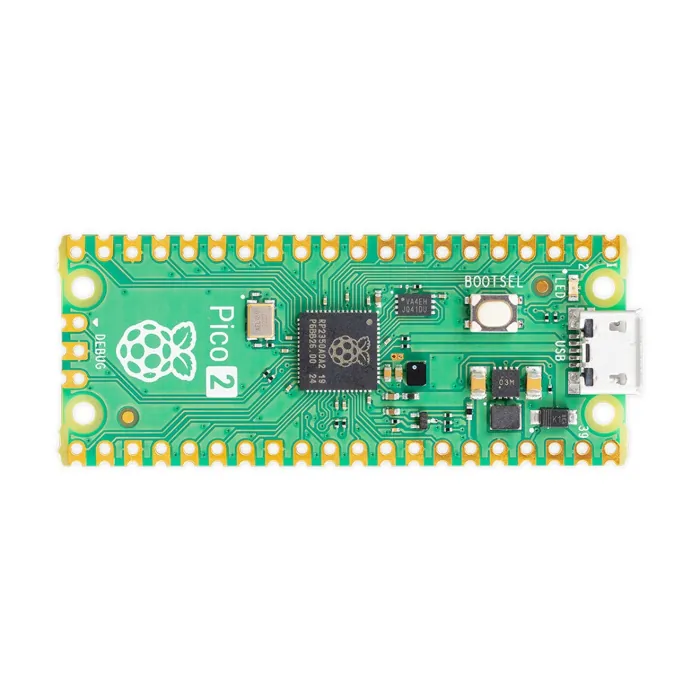
Raspberry Pi Pico 2 RP2350 Microcontroller Chip, Dual-Core 150MHz Cortex-M33/RISC-V, 520KB SRAM, Embedded Systems & IoT
The Raspberry Pi Pico 2 RP2350 is a high-performance microcontroller platform designed by Raspberry Pi for embedded systems, electronics prototyping, robotics, automation, IoT, sensor projects, and advanced programming applications. At the heart of Raspberry Pi Pico 2 is the RP2350A microcontroller, providing a major performance and memory upgrade over the original RP2040-based Pico.
The RP2350 features dual Arm Cortex-M33 processor cores running at up to 150MHz, with hardware single-precision floating-point and DSP capabilities. It also supports the open-hardware Hazard3 RISC-V architecture, allowing developers to select between dual Cortex-M33 and dual Hazard3 RISC-V cores depending on their application and software requirements.
For memory-intensive embedded applications, RP2350 provides 520KB of on-chip SRAM, while the standard Raspberry Pi Pico 2 board includes 4MB of onboard QSPI flash memory. This combination makes Pico 2 suitable for MicroPython applications, real-time control, data acquisition, robotics, displays, automation, and connected-device development.
The RP2350 also includes an enhanced Programmable I/O (PIO) subsystem with 12 state machines, enabling developers to create custom high-speed interfaces without consuming significant CPU resources. Built-in peripherals include 2× UART, 2× SPI, 2× I2C, 16 PWM channels on Pico 2, USB 1.1 host/device support, and 3× 12-bit ADC inputs exposed by the Pico 2 board.
Security is another major improvement. RP2350 incorporates Arm TrustZone for Cortex-M, secure boot capabilities, OTP storage, hardware SHA-256 acceleration, and security-domain controls for peripherals, GPIO, and DMA. These features make it attractive for applications requiring stronger embedded security.
For Bangladeshi students, electronics engineers, makers, robotics developers, and IoT enthusiasts, Raspberry Pi Pico 2 provides an affordable platform for learning embedded C/C++, MicroPython, GPIO programming, sensors, motor control, communication protocols, automation, and hardware interfacing. It is also suitable for professional prototyping and custom embedded products.
The Pico 2 retains software and hardware compatibility with the earlier Pico family while delivering higher performance, more SRAM, improved PIO capabilities, and advanced security features.
Important: Raspberry Pi Pico 2 is the complete development board based on RP2350A. The RP2350A chip itself is a 7×7mm QFN-60 device with 30 GPIOs and no integrated flash, while Pico 2 adds 4MB external QSPI flash and exposes 26 multifunction GPIO pins.
Specifications:
| Specification | Raspberry Pi Pico 2 / RP2350 |
|---|---|
| Microcontroller | Raspberry Pi RP2350A |
| CPU | Dual Arm Cortex-M33 / Dual Hazard3 RISC-V |
| Maximum Clock | 150 MHz |
| SRAM | 520 KB |
| Pico 2 Flash | 4 MB QSPI |
| GPIO | 26 multifunction GPIO on Pico 2 |
| ADC | 3 × 12-bit |
| PWM | 16 channels |
| UART | 2 |
| SPI | 2 |
| I2C | 2 |
| USB | USB 1.1 Host/Device |
| PIO | 12 state machines |
| Programming | C/C++, MicroPython |
| Board Size | 21 × 51 mm |
| Wireless | None on Pico 2; Pico 2 W adds Wi-Fi/Bluetooth |
Related Products


 Featured
Wholesale